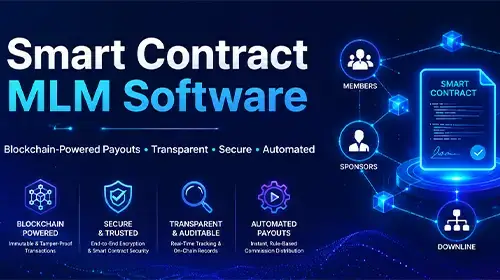
What Is Smart Contract MLM Software?
Smart contract MLM software is a next-generation network marketing platform that uses blockchain technology and self-executing smart contracts to automate distributor onboarding, commission calculations, and payout processing without relying on a central administrator.
How Smart Contracts Work in MLM?
At its core, a smart contract is a piece of code stored on a blockchain that automatically executes predefined actions when certain conditions are met. In the context of multi-level marketing, it helps automate important business actions with accuracy and transparency.
Qualifying Sale Completed
When a distributor makes a qualifying sale, the commission is calculated instantly.
Rank Condition Achieved
When a rank advancement condition is met, the reward is released automatically.
New Referral Joins
When a referral joins in the network, upline bonuses are triggered without manual approval.
In Plain Terms
With smart contracts, payouts don't need to wait for manual approval from the company admin. A secure blockchain-based program manages the process automatically, 24/7. This helps reduce delays, avoid human errors, and gives everyone a clear view of how payouts are handled.
How Traditional MLM Payouts Fall Short
Before exploring the solution, it is important to understand the problem that blockchain-powered MLM software solves. Traditional MLM payout systems often create delays, errors, and trust issues between companies and distributors.
Delayed Commissions
Best MLM platforms run commission calculations in nightly or weekly batches. Distributors may wait days or even weeks before seeing their earnings.
Manual Errors
Commission calculations across multiple downline levels, bonus pools, and rank adjustments are complex. Manual systems can lead to mistakes and disputes.
Lack of Transparency
Distributors often receive a payout amount without a clear audit trail, which can create confusion, suspicion, and loss of trust.
Centralized Control
A central server or admin team controls payouts. If there are financial issues, technical failures, or bad actors, distributor earnings may be affected.
High Administrative Overhead
Processing payments, reconciling accounts, and managing payout disputes across many distributors requires time, resources, and extra operational cost.
How Blockchain-Powered Payouts Work
Here is a simple step-by-step breakdown of how smart contract MLM software processes a payout from distributor registration to final commission transfer.
Distributor Joins the Network
A new distributor registers by interacting directly with a smart contract deployed on a blockchain such as Ethereum or Binance Smart Chain.
Compensation Rules Are Encoded
Commission percentages, rank levels, bonus triggers, binary leg balancing rules, and payout caps are encoded directly into the smart contract before deployment.
A Qualifying Event Occurs
A qualifying event such as a product sale, new recruit joining, or rank advancement is submitted to the blockchain as a transaction.
The Smart Contract Executes
The contract verifies the event, checks predefined conditions, calculates commissions for eligible upline distributors, and initiates the transfer.
Funds Are Transferred Instantly
Commissions are directly sent to distributor wallets, often in ETH, BNB, USDT, or a proprietary token. No manual approval is required.
Transaction Is Recorded on the Ledger
Every payout is safely recorded on the blockchain, so it cannot be changed later. This creates a clear and trustworthy record that participants can check anytime.
Key Components of a Smart Contract MLM System
A production-grade smart contract MLM platform includes several connected modules that work together to automate payouts, manage distributors, and improve transparency.
Smart Contract Layer
Encodes compensation rules and executes payouts automatically based on predefined conditions.
Blockchain Network
It uses blockchain networks like Ethereum, BSC, Tron, or Polygon to keep records secure, transparent, and protected from tampering.
Distributor Wallet System
Assigns a unique wallet to each participant for receiving commissions and tracking blockchain-based earnings.
MLM Back Office
Gives admins and distributors a web-based dashboard to monitor performance, payouts, rank progress, and network activity.
Genealogy Tree Engine
Tracks and visualizes the downline structure in real time, helping users understand their network growth.
KYC & AML Module
Verifies participant identity and supports compliance requirements for safer and more responsible operations.
Token/Crypto Payment Gateway
Facilitates crypto payments, stablecoin transfers, and token-based commission settlements.
Admin Control Panel
Allows administrators to manage plans, ranks, reports, settings, and operational controls from one place.
Mobile App
Gives distributors on-the-go access to earnings, downline activity, wallet updates, and important notifications.
Smart Contract MLM vs. Traditional MLM Software
Smart contract MLM software makes payouts faster and more transparent. Instead of depending on manual approvals, delayed processing, or records that only the company can see, payouts are handled automatically on the blockchain and can be verified by participants.
| Feature | Traditional MLM Software | Smart Contract MLM Software |
|---|---|---|
| Payout Speed | Days to weeks | Seconds to minutes |
| Commission Accuracy | Prone to human error | Code-executed and highly accurate |
| Transparency | Limited and admin-controlled | Publicly verifiable on blockchain |
| Centralized Risk | High, with a single point of failure | Lower risk through decentralized network design |
| Fraud Prevention | Manual audits | Cryptographic security by default |
| Global Scalability | Limited by banking and payment systems | Borderless and suitable for global users |
| Administrative Cost | High, requires human teams | Reduced through automation |
| Audit Trail | Internal logs that may be altered | Immutable blockchain ledger |
| Trust Factor | Relies on company reputation | Relies on verifiable code and public records |
| Compliance | Varies by implementation | Can be encoded into contract logic and workflows |
Supported MLM Compensation Plans
One of the most powerful aspects of smart contract MLM software is its ability to encode complex, multi-level compensation structures directly into blockchain logic.
Binary MLM Plan
Two legs, left and right, are assigned to each distributor. The smart contract tracks volume on both sides, calculates binary commissions based on the weaker leg, and releases payouts when thresholds are met.
Learn more about Binary MLM PlanUnilevel MLM Plan
In a unilevel MLM plan, distributors can sponsor unlimited frontline members, while commissions are paid across different levels of their network. Smart contracts make this process easier by automatically calculating and splitting commissions based on the set percentage rules, without any manual work.
Learn more about Unilevel MLM PlanMatrix MLM Plan
Matrix plans use fixed-width and fixed-depth structures, such as 3×9 or 4×7. The smart contract enforces placement rules and triggers spillover logic when a level fills up.
Learn more about Matrix MLM PlanGeneration MLM Plan
In a generation MLM plan, commissions are paid based on distributor generations within the genealogy tree. Smart contracts make this easier by accurately calculating generational overrides and pass-up bonuses, without manual errors.
Learn more about Generation MLM PlanHybrid Plans
Hybrid plans combine multiple MLM structures such as binary, unilevel, matrix, and generation models. Smart contract architecture allows several logic layers to operate together, supporting even complex compensation designs.
Learn more about Hybrid MLM PlanBenefits of Smart Contract MLM Software
Smart contract MLM software helps businesses automate payouts, improve trust, reduce manual work, and support global distributor networks with greater efficiency.
Instant, Automated Payouts
Smart contracts help remove the payout delays found in traditional systems. When a qualifying action happens, commissions can be calculated and sent within seconds, giving distributors a faster and smoother earning experience.
Immutable Transparency
Every transaction, commission, bonus, and rank reward is permanently recorded on a public blockchain. Distributors can independently verify their earnings at any time.
Elimination of Intermediaries
Smart contracts reduce the need for extra payment processors, commission managers, and manual reconciliation work. The payout rules are handled by code, which helps lower costs and reduce human errors.
Global, Borderless Operations
Crypto-based smart contract payouts can support distributors across different regions without depending heavily on traditional cross-border banking systems.
Cryptographic Security
Smart contracts are secured by the blockchain’s consensus mechanism. This makes unauthorized changes or payout manipulation extremely difficult.
Cost Efficiency at Scale
Once deployed, the smart contract can execute payout logic with consistent efficiency as the network grows from a small distributor base to a large global organization.
Regulatory Alignment
When smart contract MLM software is connected with KYC and AML modules, it becomes easier to support FTC guidelines and DSA compliance requirements. Compliance rules can also be built into the smart contract logic and platform workflow, helping businesses manage payouts and distributor activity more responsibly.
Problem
If a product is returned after a commission has already been paid through a smart contract, reversing the transaction becomes difficult because blockchain transactions are immutable.
Solution
Add a holdback or clawback mechanism using a time-locked escrow layer. This can hold commissions for a defined refund window, such as 14 to 30 days, before final release.
Challenges and How to Overcome Them
Smart contract MLM software can be a powerful solution, but it also comes with some technical and operational challenges. The good news is that a well-built platform can handle these complexities with the right architecture, security checks, and compliance workflows.
Challenge 1: Immutability vs. Business Flexibility
Problem
Once deployed, a smart contract's rules cannot be changed. But businesses regularly update compensation plans.
Solution
Use upgradeable proxy contracts so the platform can be updated safely when needed. This approach separates the business logic from stored data, allowing controlled upgrades through proper governance without disrupting the system.
Challenge 2: Refund Complexity
Problem
If a product is returned after a commission has been paid via smart contract, reversing the transaction is technically difficult because blockchain transactions are immutable.
Solution
Implement a holdback or clawback mechanism using a time-locked escrow layer that holds commissions for a defined period, such as 14 to 30 days, before final release.
Challenge 3: Regulatory Compliance
Problem
Decentralized systems may not fully match financial regulations in every country. That is why smart contract MLM platforms need to be designed carefully, with compliance checks that fit the rules of each operating region.
Solution
Integrate on-chain KYC and AML verification as mandatory steps before a wallet becomes commission-eligible.
Challenge 4: Gas Fees
Problem
On high-traffic blockchain networks like Ethereum mainnet, transaction fees can make micro-commissions uneconomical.
Solution
Deploy on Layer 2 networks like Polygon or Arbitrum, or use alternative chains like Binance Smart Chain and Tron that offer lower fees.
Challenge 5: User Complexity
Problem
Many distributors are not crypto-native and may find wallet management intimidating.
Solution
Abstract wallet complexity through a user-friendly back office interface that shows earnings in familiar currency equivalents, with automatic conversion to stablecoins like USDT.
Blockchain Networks Used in MLM Systems
The choice of blockchain directly impacts payout speed, transaction costs, and scalability. Here is how the major networks compare for MLM use cases:
| Blockchain | Speed |
Fee Level |
Best For |
|---|---|---|---|
| Ethereum (ETH) | Moderate | High | High-value payouts; maximum security |
|
Binance Smart Chain (BSC) |
Fast | Low | Cost-efficient mass payouts |
| Tron (TRX) | Very Fast | Very Low | High-volume, micro-commission structures |
| Polygon (MATIC) | Very Fast | Very Low | Ethereum compatibility with low fees |
| Solana (SOL) |
Ultra- Fast |
Minimal | High-frequency, large-network operations |
Business MLM Software supports deployment across multiple chains, with the ability to select the network that best fits your business scale, commission frequency, and geographic reach.
Is Smart Contract MLM Software Right for Your Business?
Smart contract MLM software is an excellent fit for organizations that want transparent payouts, global scalability, and automated commission processing.
It Is an Excellent Fit For Organizations That:
Value distributor trust and want a transparent, independently verifiable payout system.
It is a good fit for businesses that operate globally and want to make cross-border payments faster, easier, and less complicated.
Have a high volume of transactions where automation creates significant operational savings.
It is ideal for new MLM businesses that want to build trust from the beginning by using blockchain-backed transparency for payouts, records, and distributor activity.
It is useful for businesses moving away from an old MLM system where commission errors, delays, or unclear records have caused disputes with distributors.
It May Require Additional Planning For Organizations That:
It is also suitable for businesses that need to update their compensation plan often. With upgradeable smart contracts, plan rules can be changed in a controlled and secure way without rebuilding the entire system.
Operate in jurisdictions with strict cryptocurrency regulations. This can be solved with compliant crypto gateways and KYC integration.
Have a primarily non-crypto-native distributor base. This can be solved with an abstracted wallet user experience.
In most cases, these challenges are engineering problems with known solutions, not fundamental blockers.
Why Choose Business MLM Software for Blockchain-Powered Payouts
Business MLM Software offers a production-ready smart contract MLM platform built for MLM companies that need reliability, compliance, and scale.
What Sets Our Platform Apart
Pre-Audited Smart Contracts
Our contracts are security-audited before deployment, with on-chain rules and automated payout verification.
Multi-Chain Support
Deploy on Ethereum, BSC, Tron, or Polygon based on your operational needs.
Full Back Office Integration
Smart contract payouts feed directly into the familiar MLM back office dashboard, genealogy tree, and distributor portal.
KYC & AML Built In
Compliance is built directly into the smart contract rules from the start, instead of being added later as an extra layer.
Mobile-First Experience
Distributors can manage earnings, downline activity, and rank progress through iOS and Android apps.
Major Compensation Plan Support
Supports binary, unilevel, matrix, generation, and custom hybrid compensation structures.
Trusted by 1,000+ MLM Companies Across 50+ Countries
We pair the transparency of blockchain with the operational familiarity of a traditional MLM back office, so your distributors and admin team both get the experience they need.
Conclusion
Smart contract MLM software is shaping the next stage of network marketing technology. It replaces slow, manual payout systems with blockchain-based rules that run automatically and transparently. This helps solve three major challenges in direct selling: payout delays, commission disputes, and lack of distributor trust.
As the global direct selling market continues to grow toward a $186 billion valuation, companies need systems that can scale with them. Relying on outdated platforms and manual fixes can slow down growth and create unnecessary risks.
Whether you are starting a new MLM business or moving from an existing system, blockchain-powered payouts give your distributors more confidence. They can see that their commissions are calculated accurately, paid automatically, and verified through transparent blockchain records.
Frequently Asked Questions
1. What is smart contract MLM software?
Smart contract MLM software helps to automate important tasks like distributor onboarding, commission calculations, and payouts using blockchain technology. Instead of relying on manual work, the system follows predefined rules and processes payments automatically, making the entire MLM operation faster, more transparent, and easier for distributors to trust.
2.How fast are smart contract MLM payouts?
Depending on the blockchain network used, payouts can usually be completed within seconds or a few minutes. This is much faster than traditional batch-processing systems, where distributors may need to wait days or even weeks to receive their commissions.
3. Is smart contract MLM software secure?
Yes. Smart contracts are protected by blockchain security and cryptographic verification. Once the rules are deployed, they cannot be changed casually or secretly. Any update usually needs a proper governance or approval process, which makes commission manipulation extremely difficult.
4. Which blockchain networks work best for MLM smart contracts?
Binance Smart Chain, Tron, and Polygon are good choices for MLM businesses that need fast payouts with lower transaction costs, especially when handling a large number of commissions. Ethereum is better suited for businesses that prioritize stronger security and higher-value transactions.
5. Can smart contract MLM software support binary and matrix plans?
Yes. Business MLM Software can convert major compensation plans like binary, unilevel, matrix, generation, and hybrid into smart contract logic. This helps automate commission rules, reduce manual errors, and make payouts more transparent for distributors.
6. How does smart contract MLM handle refunds?
A holdback or time-locked escrow option can be added to delay the final commission payout until the refund period is over. This gives the business more flexibility while still keeping the smart contract rules secure and transparent.
7. Is smart contract MLM software FTC compliant?
When combined with proper KYC/AML modules and a product-sale-based compensation structure (not recruitment-only), smart contract MLM systems can be built to align with FTC and DSA guidelines.
8. How much does smart contract MLM software cost?
The cost depends on your project requirements, including the compensation plan, blockchain network, and overall system complexity. You can contact the Business MLM Software team for a custom quote based on your network size, plan structure, and preferred blockchain.
About The Author


Reja is a skilled Content Writer with strong expertise in the MLM industry, direct selling business models, and software-based solutions. With a clear understanding of MLM compensation plans, distributor management, commission automation, genealogy structures, and compliance-focused content, she creates content that is both technically accurate and easy to understand.