Choosing the right MLM software is an important decision for any network marketing business. It directly affects how smoothly your operations run, especially as your distributor network grows.
As your business expands, managing team structures, tracking performance, and calculating commissions can become complex. A reliable MLM software helps simplify these tasks by automating processes and keeping everything organized in one place.
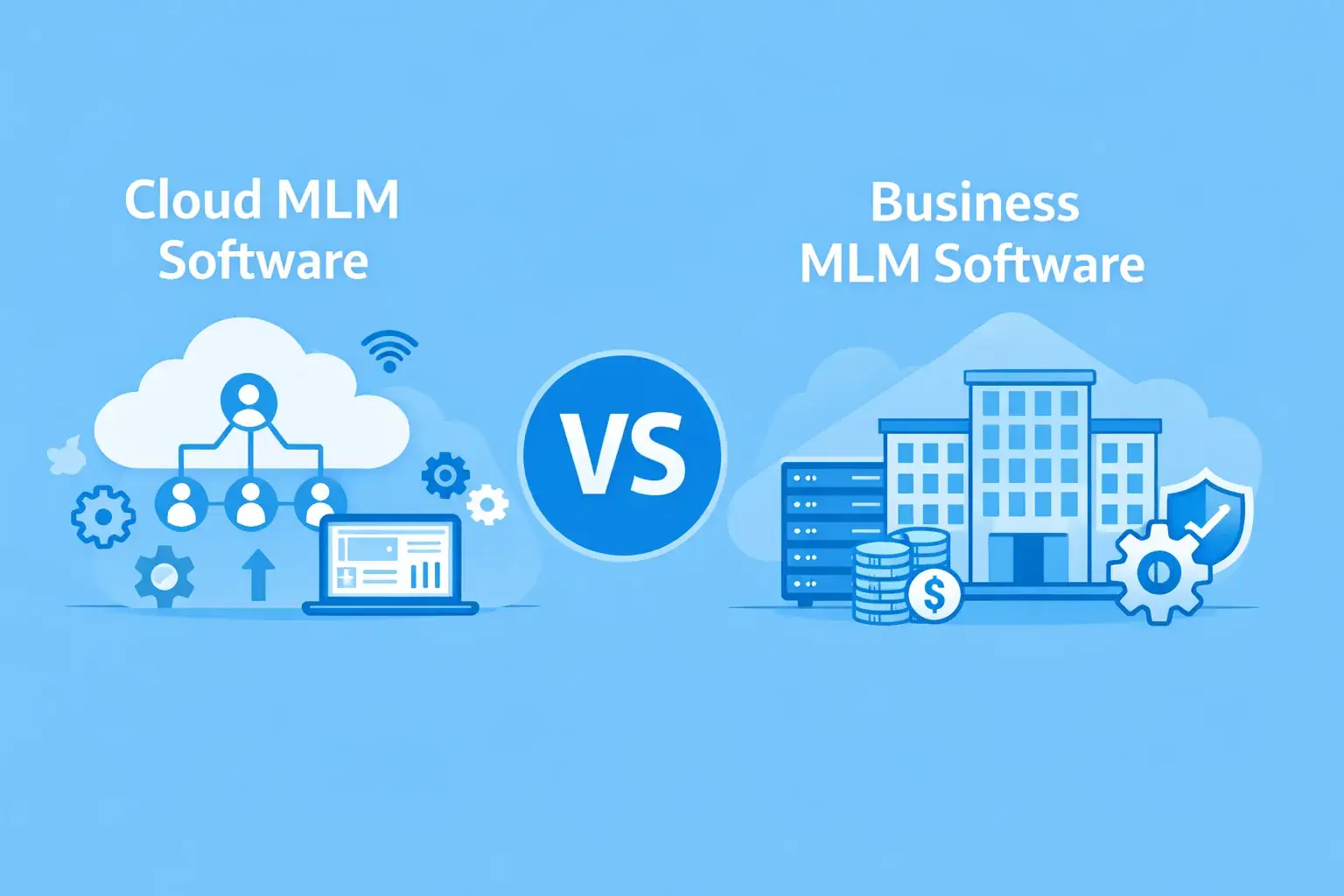
When exploring options, most businesses come across two common choices: Cloud MLM Software and Business MLM Software. Both are designed to support network marketing operations, but they differ in areas such as setup, scalability, cost, and maintenance.
This comparison is created to help you clearly understand these differences, so you can choose a solution that aligns with your business needs and future growth.
What Is Cloud MLM Software?
Cloud MLM Software is a cloud-hosted network marketing platform that runs on remote servers and is accessed via the internet, eliminating the need for local infrastructure and maintenance.
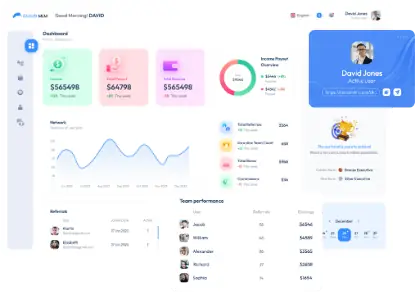
A cloud MLM system allows companies to manage their entire network marketing operations without handling servers, installations, or updates. It is typically offered as a SaaS solution, making it flexible, scalable, and easy to deploy.
Key Characteristics
- ✔ Hosted on cloud infrastructure (AWS, Google Cloud, Azure)
- ✔ Accessible from anywhere via browser or mobile
- ✔ Automatic software updates
- ✔ Subscription-based pricing model
- ✔ High scalability for growing networks
Core Features
- ✔ Distributor management
- ✔ Commission automation
- ✔ Genealogy tree management
- ✔ E-wallet & payment integration
- ✔ Replicated websites
- ✔ Real-time analytics
- ✔ API integrations
- ✔ Mobile accessibility
Since everything is hosted in the cloud, businesses can launch quickly without complex technical setup, making it an ideal choice for modern MLM companies.
What Is Business MLM Software?
Business MLM Software refers to traditional network marketing systems installed on private servers or dedicated infrastructure, offering greater control but requiring technical management.
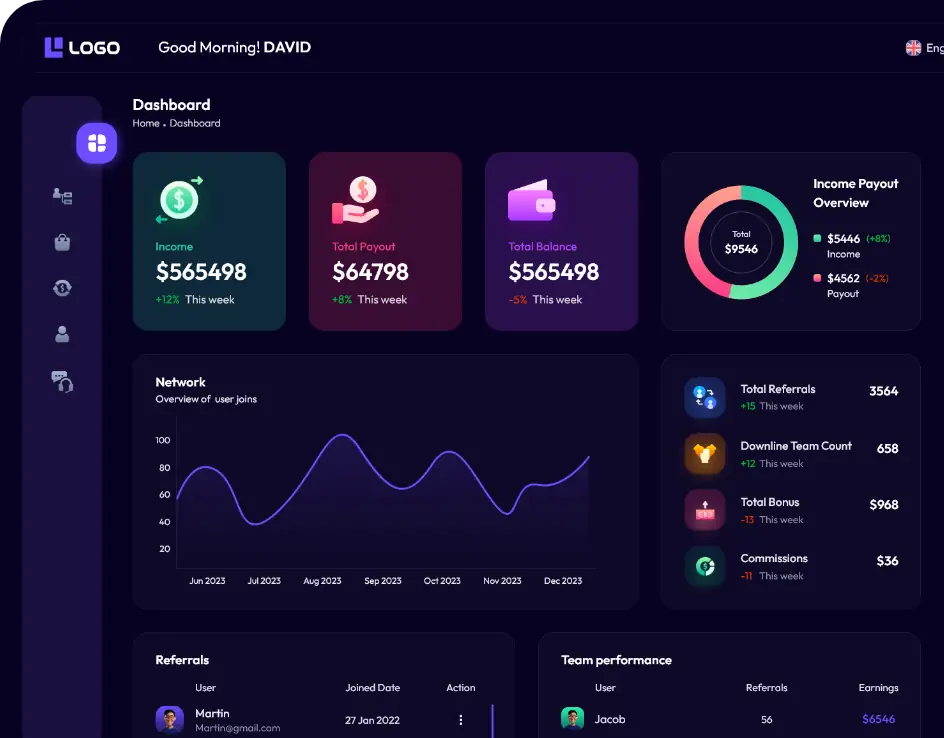
This type of MLM software is typically set up on a company’s own server or hosted environment. It provides full control over customization and system configuration but requires ongoing maintenance, updates, and technical expertise.
Key Characteristics
- ✔ Installed on private servers or company infrastructure
- ✔ Customizable according to business rules
- ✔ Usually purchased through a one-time license
- ✔ Requires manual upgrades and maintenance
- ✔ Higher control over system configuration
Core Features
- ✔ Compensation plan management
- ✔ Downline tracking
- ✔ Distributor account management
- ✔ Product and order management
- ✔ Commission processing
- ✔ Custom integrations
Business MLM systems are often preferred by companies that require deep customization, full infrastructure control, and flexibility to adapt the platform to their specific business logic.
Key Differences Between Cloud MLM Software and Business MLM Software
Although both software serve the same purpose, their architecture and operational models are very different.
| Category | Cloud MLM Software | Business MLM Software |
|---|---|---|
| Infrastructure | Hosted on cloud servers and accessed online | Installed on dedicated or private servers |
| Maintenance | Maintenance handled by the provider | Requires internal technical management |
| Deployment Speed | Ready within days | May take weeks for setup and configuration |
| Cost Model | Subscription-based | Often license-based with hosting costs |
Feature Comparison Table
This comparison highlights how Cloud MLM Software and Business MLM Software differ in flexibility, scalability, and technical complexity.
| Feature | Cloud MLM Software | Business MLM Software |
|---|---|---|
| Deployment | Cloud-based SaaS | On-premise or private server |
| Setup Time | Fast deployment | Longer setup process |
| Maintenance | Managed by provider | Managed by internal team |
| Scalability | Highly scalable | Limited by server capacity |
| Accessibility | Accessible anywhere | Depends on infrastructure |
| Updates | Automatic updates | Manual upgrades |
| Initial Cost | Lower initial investment | Higher upfront cost |
| Customization | Moderate customization | High customization |
| Security Management | Provider-managed | Company-managed |
This comparison table shows the key differences between the two systems, especially in terms of flexibility and technical requirements.
Advantages of Cloud MLM Software
Cloud-based platforms have become increasingly popular because they offer speed, scalability, and lower operational complexity.
Easy Deployment
Companies can launch their network marketing software platform quickly without purchasing infrastructure.
Automatic Updates
Software providers handle system updates, security patches, and performance improvements.
High Scalability
A cloud MLM system can support large distributor networks without requiring additional hardware.
Remote Accessibility
Distributors and administrators can access the system from anywhere.
Lower Technical Management
There is no need to maintain servers or manage infrastructure internally.
Advantages of Business MLM Software
Despite the growing popularity of cloud solutions, MLM business software still offers several advantages for organizations that need more control and flexibility.
Full System Control
Companies have complete control over infrastructure, security policies, and deployment.
Advanced Customization
Business MLM platforms can be customized to support complex compensation plans and workflows.
One-Time Licensing
Many systems operate on a license model instead of monthly subscriptions.
Data Ownership
Organizations retain full control of their data storage environment.
Disadvantages of Each Solution
Understanding the limitations of each platform is important before selecting the best MLM software.
Cloud MLM Software Limitations
- – Monthly subscription costs
- – Limited infrastructure control
- – Customization may depend on provider capabilities
- – Requires internet connectivity
Business MLM Software Limitations
- – Higher setup costs
- – Requires technical maintenance
- – Slower deployment
- – Infrastructure scalability challenges
These factors often influence whether a company chooses a cloud MLM system or a traditional MLM business software platform.
Pricing and Scalability Comparison
Pricing models differ significantly between the two systems.
Cloud MLM Software Pricing
- • Number of users
- • Distributor network size
- • Feature access
- • API integrations
Typical SaaS pricing models allow companies to scale as their network grows.
Business MLM Software Pricing
- • One-time license cost
- • Server infrastructure investment
- • Maintenance and upgrade costs
- • Development customization fees
While the initial cost may be higher, some companies prefer this model for long-term control.
Scalability
Cloud MLM systems can easily handle growth, as the cloud infrastructure adjusts to increased users and activity without much effort.
On the other hand, Business MLM software usually requires manual upgrades to the system when the network expands.
For businesses expecting fast distributor growth, cloud-based solutions generally offer more flexibility and ease of scaling.
Security Considerations
Security is a critical factor when selecting a network marketing software platform.
Cloud MLM Security
- ✔ Data encryption
- ✔ Automated backups
- ✔ Server monitoring
- ✔ Distributed infrastructure
- ✔ Disaster recovery systems
Many cloud platforms operate on enterprise-grade infrastructure such as AWS or Google Cloud.
Business MLM Security
- ✔ Server configuration management
- ✔ Security patch handling
- ✔ Backup system setup
- ✔ Data protection policies
Companies with experienced IT teams may prefer this level of control.
Use Cases: Startups vs Enterprises
Different types of MLM companies benefit from different solutions based on their scale, resources, and operational needs.
Startups & Emerging MLM Companies
Startups often prefer cloud MLM software because it provides:
- ✔ Quick launch capability
- ✔ Lower upfront investment
- ✔ Minimal technical management
- ✔ Easy scaling as the network grows
For companies launching their first network marketing software platform, cloud solutions are usually the most practical and easy-to-manage option.
Large Enterprises & Established MLM Companies
Large organizations may choose business MLM software if they require:
- ✔ Deep customization of compensation plans
- ✔ Internal infrastructure control
- ✔ Integration with enterprise systems
- ✔ Strict compliance and data policies
These companies often have the technical resources required to manage complex systems.
Final Recommendation: Which MLM Software Is Best?
Choosing between Cloud MLM Software vs Business MLM Software ultimately depends on your company’s operational needs, technical resources, and growth strategy.
Choose Cloud MLM Software If
- ✔ You want fast deployment
- ✔ You prefer SaaS subscription pricing
- ✔ Your company expects rapid distributor growth
- ✔ You want minimal infrastructure management
Choose Business MLM Software If
- ✔ You require deep customization
- ✔ You want full infrastructure control
- ✔ Your company has an internal technical team
- ✔ You prefer a license-based system
For most modern
top MLM companies
, cloud-based MLM software is becoming the preferred choice because it is easy to scale, flexible, and simple to use.
However, businesses with specific or advanced requirements may still find traditional MLM business software to be a better fit.
Conclusion
Both Cloud MLM Software and Business MLM Software offer strong features to manage distributor networks, automate commission calculations, and support business growth.
A cloud-based MLM system is ideal for companies looking for flexibility, quick setup, and easy scalability. On the other hand, traditional MLM business software is better suited for organizations that need more control and advanced customization.
The right choice depends on your business size, future growth plans, and available technical resources. By considering these factors, you can select an MLM software that supports your long-term goals and keeps your operations running efficiently.
Frequently Asked Questions
1. What is the main difference between cloud MLM software and business MLM software?
Cloud MLM software can be hosted on private servers, offering full control over customization, data, and infrastructure, while business MLM software is hosted online and managed by the provider.
2. Which is better for startups: cloud MLM software or business MLM software?
Startups usually prefer cloud MLM software because it requires less upfront investment, offers faster deployment, and does not need in-house technical maintenance.
3. Is cloud MLM software more scalable than business MLM software?
Yes, cloud MLM software is generally more scalable since it allows businesses to expand globally without worrying about server limitations or infrastructure upgrades.
4. Do I get full data control with cloud MLM software?
Yes, Cloud MLM software offers complete ownership and control over your data environment.
5. What are the cost differences between cloud MLM software and business MLM software?
The cost difference between cloud MLM software and business MLM software is minimal, but the pricing models may vary slightly. Cloud MLM software is available at a one-time payment of $750, while business MLM software is priced at $650. The difference of $100 reflects variations in hosting, management, and service structure offered by each solution.”